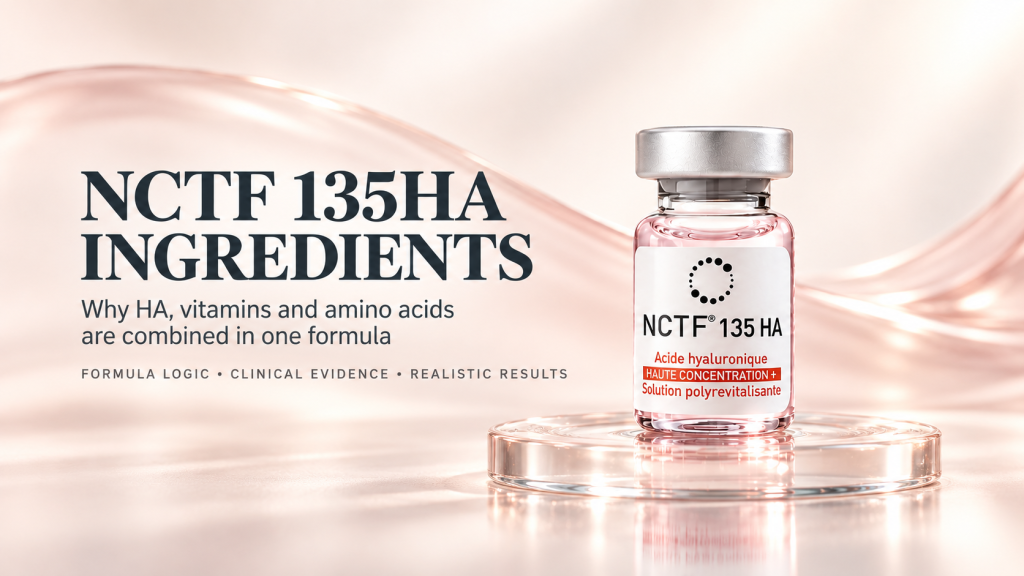
The quick answer: NCTF 135HA is a professional injectable skin-revitalisation formula built around 5 mg/mL of free, non-cross-linked hyaluronic acid (HA) rather than a firm volumising gel. Current FILLMED material describes a formula of 60 essential ingredients and highlights 12 vitamins, 24 amino acids, 6 coenzymes, 5 nucleosides, 6 minerals and glutathione. HA has the clearest direct hydration role; the other groups are included as metabolic cofactors, building blocks or antioxidants intended to support the environment in which skin cells function.
That composition is biologically plausible, but the important evidence distinction is this: human studies test the finished NCTF 135HA formula, not each ingredient separately. The available clinical evidence supports gradual, generally subtle improvements in superficial wrinkles, radiance and some hydration measures after a course. It does not prove that every listed ingredient independently “makes collagen,” nor does it support claims of structural filling, lifting, permanent skin change or guaranteed dramatic before-and-after results.
The useful way to read the formula: HA explains much of the immediate hydration logic. Vitamins, amino acids and the supporting groups explain why NCTF is positioned as a polyrevitalising formula. Clinical trials tell us what the complete product may do; they do not let us credit one vitamin or amino acid for the result.
What is NCTF 135HA, and is it a dermal filler?
NCTF 135HA is a skin-quality injectable, not a structural dermal filler. Both categories may contain HA, but the form and purpose are different. A contouring filler uses a cross-linked HA gel designed to retain shape and create projection. NCTF uses free, non-cross-linked HA at 5 mg/mL in a fluid multi-ingredient solution intended for superficial skin revitalisation.
That difference matters when setting expectations. NCTF may be considered when the goal is to improve the look of dehydration, fine surface lines, dullness or generally tired-looking skin. It is not designed to build a cheek, project a chin, reshape a jawline or fill a deep tear trough. Early post-treatment swelling can temporarily make an area look fuller, but swelling is not a filler result and should not be used as proof that the treatment has worked.
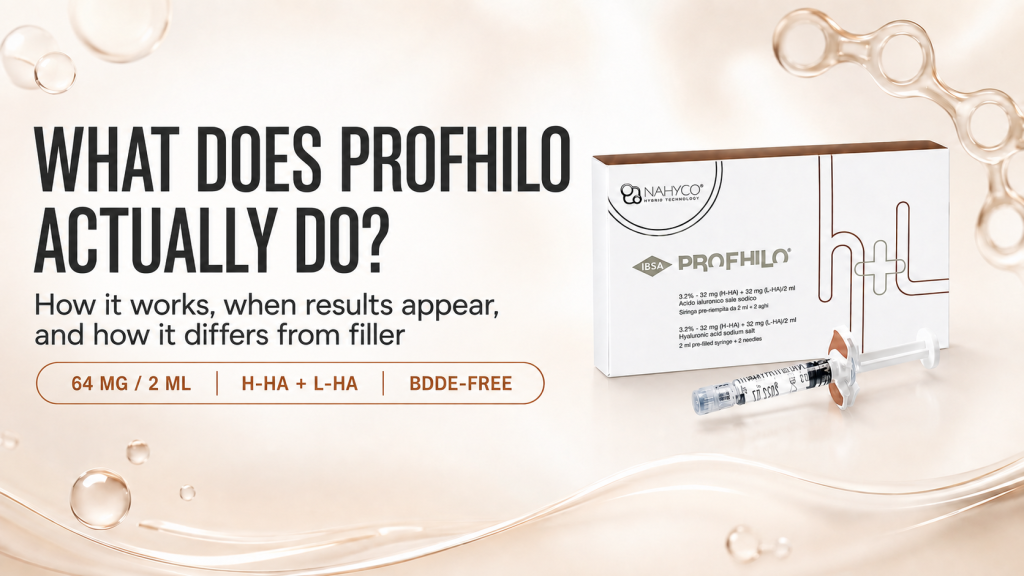
People also compare NCTF with Profhilo because both are associated with HA and skin quality. They are not interchangeable formulas. Profhilo is a concentrated, thermally stabilised HA product with a different composition and treatment concept, while NCTF is a low-concentration free-HA solution combined with multiple nutrient families. For a fuller category explanation, see what Profhilo is and how it works. This article stays focused on what the NCTF formula contains and how strong the evidence is.
What exactly is in NCTF 135HA?
The current official ingredient summary is best understood by families, not as a list of 60 miniature treatment claims. The major groups and their intended roles are shown below.
| Ingredient group | Current official summary | Why it is included | What the presence of the ingredient does not prove |
|---|---|---|---|
| Free hyaluronic acid | 5 mg/mL | Water binding and support for a hydrated extracellular environment | Structural filling, lifting or permanent volume |
| Vitamins | 12 | Cofactors in cell metabolism; vitamins C and E also have antioxidant roles | That each vitamin reaches a clinically effective target or independently changes skin |
| Amino acids | 24 | Building blocks used in protein synthesis, including proteins found in skin matrix | A guaranteed quantity of new collagen or elastin |
| Coenzymes | 6 | Help enzymes carry out metabolic reactions | Faster metabolism or visible rejuvenation from the coenzymes alone |
| Nucleosides | 5 | Components used in DNA and RNA synthesis and cellular turnover pathways | “DNA repair” as a guaranteed cosmetic outcome |
| Minerals | 6 | Support enzyme activity, electrolyte balance and cellular reactions | That mineral injection corrects a nutritional deficiency |
| Glutathione | Listed separately | Antioxidant support within the formula | Reliable skin whitening or treatment of melasma and dark circles |
The current FILLMED practitioner brochure uses the headline “60 essential ingredients,” while older papers and legacy product descriptions may use different totals or describe “53 components plus HA.” This is not a good reason to invent a new count. Ingredient naming, grouping and formula generations can differ across documents. For purchasing, the current carton, local instructions for use and batch documentation should take priority over a number copied from an older clinic page.
Why is free hyaluronic acid the hydration base?
Hyaluronic acid is a naturally occurring glycosaminoglycan with a strong affinity for water. In skin, HA contributes to the hydrated extracellular environment around cells. The free HA in NCTF is therefore the most direct explanation for the product’s hydration positioning.
“Free” and “non-cross-linked” are important words. Cross-linking joins HA chains into a more durable gel that can resist breakdown and hold shape. Free HA is more fluid and is broken down more readily. That makes it appropriate to discuss NCTF as a skin-quality solution, but not as a long-lasting volume replacement.
The 5 mg/mL concentration should also be read accurately. It identifies how much HA is present; it does not predict how many millimetres of wrinkle reduction a customer will obtain. Hydration readings can change with climate, skincare, recent procedures, sleep and the measuring device. HA provides a sound formulation rationale, while the size and duration of the visible result still need clinical evidence.
What do the 12 vitamins contribute?
The vitamin group is included mainly because vitamins act as cofactors in cellular processes, while some also participate in antioxidant defence. For example, vitamin C is involved in enzymatic steps needed for normal collagen synthesis, and vitamins C and E can help neutralise reactive oxygen species.
That mechanism is often overextended in marketing. Saying that vitamin C is required for collagen biology is not the same as proving that the amount of vitamin C in NCTF causes a measured amount of new collagen in human facial skin. The same caution applies to claims that the vitamin blend “energises cells” or reverses ageing. Those phrases describe a rationale, not a separately demonstrated outcome.
The credible claim is narrower: the formula supplies multiple water-soluble and antioxidant vitamin cofactors in the same solution as HA. Whether that multi-vitamin environment materially improves the outcome over HA alone has not been isolated by the available human trial design.
Why include 24 amino acids?
Amino acids are the raw materials from which cells assemble proteins. Collagen and elastin are proteins, so supplying a broad amino-acid pool fits the product’s polyrevitalisation concept. Amino acids also participate in cell signalling, osmoregulation and numerous metabolic pathways.
However, availability is not the same as production. A construction site can receive bricks without guaranteeing that a building will be completed; it still needs instructions, labour, energy and the right conditions. In the same way, the presence of amino acids does not prove that fibroblasts will produce a fixed amount of collagen or that visible laxity will be lifted.
This is one of the most useful distinctions for customers reading the label. “Contains collagen building blocks” is reasonable. “Creates new collagen because it contains 24 amino acids” is too certain unless a clinical study directly measures that causal chain in the finished product.
What do coenzymes, nucleosides and minerals do?
These supporting groups are included to make the formula more like a biochemical environment than a single-active HA solution. Coenzymes help enzymes complete metabolic reactions. Minerals can act as enzyme cofactors and help maintain ionic conditions. Nucleosides are components used when cells synthesise DNA and RNA.
This does not mean NCTF replaces nutrition, treats vitamin or mineral deficiency, or “feeds” the skin in the same way food feeds the body. It also does not establish that nucleosides repair damaged DNA after injection. The formulation idea is to provide several categories of small molecules that normal cell processes use. The clinical question is whether the complete, stable formulation improves visible skin outcomes—not whether every biochemical function associated with those molecules occurs to a meaningful degree after treatment.
A 2015 review of polycomponent mesotherapy formulations explains the biological rationale for combining HA, vitamins, amino acids, coenzymes, nucleosides and minerals. It also makes an essential caution: putting many ingredients together does not automatically guarantee efficacy. Concentration, stability, compatibility and what remains available in tissue all matter.
What is glutathione doing in the formula?
Glutathione is included as an antioxidant, not as proof that NCTF is a skin-whitening treatment. Antioxidants can help manage reactive oxygen species within biological systems, which is a reasonable supporting role in a skin-revitalisation formula.
The presence of glutathione is sometimes turned into claims about melasma, dark circles or dramatic lightening. The clinical studies reviewed for this guide do not establish NCTF 135HA as a targeted pigment treatment. A brighter appearance may reflect improved surface hydration, radiance or light reflection; it should not be presented as reliable removal of brown pigment, vascular colour or anatomical shadow.
Why combine all these groups in one formula?
The formulation logic is to combine hydration with a broad set of substrates, cofactors and antioxidants that skin cells normally use. HA supports the extracellular water environment, amino acids supply protein building blocks, vitamins and coenzymes participate in metabolic reactions, minerals support enzyme function, nucleosides support nucleic-acid pathways, and glutathione contributes antioxidant capacity.
The benefit of one finished formula is also practical: the manufacturer controls the concentrations, pH, sterility and compatibility of the mixture rather than asking a practitioner to improvise a cocktail. “Combined” should never mean that separate products can be mixed into NCTF or that a treatment can be recreated from individual ingredients.
The word synergy requires care. The groups have complementary biological roles, but the clinical trials do not tell us whether the combination is better than the same amount of free HA alone, nor which group contributes most. The strongest statement is that NCTF is deliberately formulated as a multi-component solution and has human evidence for the complete product.
What does the clinical evidence actually show?
The best available human evidence supports modest skin-quality improvement after a course, with important limits. A 2023 randomised multicentre study enrolled 146 adults and allocated participants in a 3:1 ratio to NCTF 135HA plus a moisturising cream or the cream alone. The NCTF group received three sessions. At later assessments, superficial-wrinkle and radiance measures favoured the NCTF group, while hydration increased at a measurement taken one week after the final treatment.
The PubMed record for the trial is useful because it reports the study design and outcomes, but it should not be read as independent proof of every marketing statement. The study was funded by FILLMED, one author was affiliated with the company, and the comparator was moisturiser alone rather than another injectable. The trial tests the finished product, so it cannot tell us that the amino acids, vitamins or HA individually caused the changes.
| Customer question | What the evidence supports | What remains unproven |
|---|---|---|
| Can skin look smoother or more radiant? | The randomised study reported improvement in superficial wrinkles and radiance after a three-session course | A dramatic transformation for every person |
| Does it hydrate? | Hydration increased in the treated group at a post-course measurement | Long-lasting superiority over other skin boosters or the independent effect of the 5 mg/mL HA |
| Does it stimulate collagen? | Ingredient biology and laboratory work provide a plausible rationale | A guaranteed amount of new collagen in each patient or proof that one ingredient caused it |
| Does it lift or fill? | This was not the product’s structural purpose | Cheek projection, tear-trough filling, jawline reshaping or surgical-style lifting |
| Is every ingredient necessary? | The finished formulation has clinical data | Head-to-head evidence showing that all 60 are required or that the combination beats HA alone |
Online before-and-after images deserve the same discipline. Changes in lighting, camera distance, expression, makeup and short-term swelling can exaggerate a “glow” result. A realistic evaluation uses the same lighting and angle and waits until the early injection response has resolved.
When should results be judged, and what course is usually planned?
NCTF is better evaluated as a course than as an instant one-session treatment. Current official material describes three sessions spaced three weeks apart: day 0, approximately week 3 and approximately week 6. That schedule also matches the core design used in the larger clinical study.
| Time point | What may be happening | What to assess |
|---|---|---|
| Same day to the first few days | Redness, papules, tenderness, swelling or bruising may affect appearance | Recovery and whether symptoms are settling—not final efficacy |
| Around week 3 | The first reaction should have resolved before the next planned session | Tolerance, early hydration or texture change and whether the original goal is still appropriate |
| Around week 6 | A typical three-session course reaches its final treatment | Do not judge the finished result from fresh swelling |
| Several weeks after the course | Surface hydration, radiance and fine-line change can be assessed more fairly | Compare standardised photographs and decide whether the improvement is meaningful |
| About three to four months from the start | The 2023 trial included later assessments at days 75 and 120 | Persistence of the result and whether maintenance is justified |
More sessions are not automatically better. The useful plan is an initial course with a defined reassessment, not an indefinite calendar. Skin condition, age, sun exposure, smoking, skincare, concurrent treatments and the cause of the concern can all affect the result. If the treatment is not addressing the real problem—such as structural hollowing, active pigment disease or significant laxity—repeating it is unlikely to turn it into a different category of procedure.
This guide does not provide injection depth, points, volumes per point or device technique. Those decisions depend on the current local instructions, anatomy and a qualified practitioner’s assessment.
NCTF 135HA aftercare: what should you do?
The immediate priorities are to reduce contamination, heat, friction and unnecessary inflammation while the injection sites settle. Use the written aftercare supplied by the treating clinic and the current local instructions for the exact product.
During the first 24 hours
As a common post-injection precaution, keep hands away from the treated area and do not rub or massage it unless the practitioner has given a specific reason. Delay makeup until the puncture sites have closed and the clinic’s stated waiting period has passed. Keep skincare simple; avoid strong acids, retinoids, scrubs and fragranced products on freshly treated skin. Avoid strenuous exercise, alcohol excess, hot showers, saunas and other heat exposure that can intensify redness or swelling. The exact local IFU and the clinic’s written instructions take priority if they set a different time window.
For the next few days
Use gentle cleansing, moisturiser and broad-spectrum sun protection. Let papules, mild swelling or bruising settle rather than pressing or puncturing them. Avoid swimming and treatments that disrupt the skin barrier until the sites are calm. If another injectable, peel, laser or microneedling procedure is planned, coordinate the interval with the treating professional instead of stacking procedures because the surface happens to look normal.
Mild redness, small raised points and swelling may last from several hours to a few days. The trend matters: symptoms should improve. Take a clear photograph and contact the clinic if the area becomes increasingly painful, hot, firm or swollen, or if a new rash develops.
Which side effects are common, and which signs need medical review?
Common short-term reactions include redness, swelling, tenderness, burning, small nodules or papules and bruising. Infection, allergic reactions, persistent inflammatory nodules and granulomatous reactions are less common but are listed risks in official material.
Contact the treating clinic promptly if inflammation persists beyond a week, a lump is not softening, swelling returns after improving, pain is increasing, or there is discharge, fever or a spreading rash. Seek urgent medical assessment for severe or rapidly escalating pain, pale or blanched skin, dusky or mottled colour, cool skin, blistering, facial weakness or any visual symptom such as blurred vision, double vision, eye pain or vision loss. These are not routine “downtime” signs.
NCTF should not be used in people with hypersensitivity to its constituents, active disease or infection in the treatment area, certain autoimmune histories or immunotherapy, and it is not intended for people under 18 or during pregnancy or breastfeeding according to current official information. Medical history and medication review belong to the treating clinician; customers should not stop prescribed medicine in order to qualify for an elective procedure.
How should a professional buyer verify NCTF 135HA before ordering?
Verify the current physical product and documentation, not just the phrase “60 ingredients.” A professional order should match the exact NCTF 135HA name, current FILLMED presentation, sealed carton, batch number, expiry date, storage requirements and local instructions. The current brochure shows a ready-to-use presentation containing five 3 mL vials, but the quotation and received carton should still be checked because market presentations and packaging can change.
| Buying check | Why it matters |
|---|---|
| Exact product name and manufacturer presentation | Prevents confusion with older NCTF variants or similarly named skin boosters |
| Batch and expiry on carton and primary container | Supports traceability and stock rotation |
| Intact tamper evidence and readable label | Helps identify damaged, substituted or questionable stock |
| Current ingredient/IFU documentation | Resolves legacy ingredient-count differences and local restrictions |
| Storage and transport record | A long ingredient list is irrelevant if product integrity has not been maintained |
| Supplier invoice and issue-reporting route | Gives the clinic a traceable path if packaging or product condition is wrong |
MJS is the sales channel for the NCTF 135HA product listing, not the manufacturer and not the treating clinic. Product selection, patient suitability and treatment technique remain clinical decisions.
Frequently asked questions
Does NCTF 135HA really work?
There is human clinical evidence that the finished formula can improve superficial-wrinkle and radiance measures after a three-session course, with some hydration improvement recorded. The expected change is skin quality, not structural filling. The evidence does not guarantee a result for every customer or prove the individual contribution of each ingredient.
Is NCTF 135HA a filler?
No. It contains free, non-cross-linked HA at 5 mg/mL and is used as a fluid skin-revitalisation solution. It is not designed to create the shape, projection or durable volume of a cross-linked dermal filler.
Why do some NCTF ingredient lists use different totals?
Current official material uses “60 essential ingredients,” while older scientific and product documents may group the formula differently or describe earlier versions. Check the current box and local IFU for the batch being purchased rather than treating one legacy number as universal.
Does NCTF make new collagen?
The formula includes amino acids and vitamin cofactors involved in normal collagen biology, and laboratory work provides a plausible mechanism. The available human trials evaluate visible skin outcomes from the full product; they do not establish a guaranteed amount of new collagen or show which ingredient caused it.
Can NCTF lighten dark circles or melasma because it contains glutathione?
That is not an evidence-supported promise. Glutathione has an antioxidant role in the formula, but NCTF trials do not establish it as a targeted treatment for melasma, brown under-eye pigment, vascular colour or anatomical shadow.
How many NCTF 135HA sessions are usually planned?
Current official material describes three sessions at three-week intervals. The plan should include a post-course review so that maintenance is based on a meaningful result and normal recovery, not on an automatic schedule.
Can NCTF 135HA be used for microneedling or self-injection?
This article does not support DIY use or repurposing the injectable formula for an unlisted technique. Follow the current local IFU and qualified professional use requirements for the exact product. Social-media demonstrations are not a substitute for sterility, anatomical training or complication management.
The useful conclusion
NCTF 135HA is not persuasive because it has the longest ingredient list. Its credible proposition is more specific: 5 mg/mL free HA supplies the hydration base, while vitamins, amino acids, coenzymes, nucleosides, minerals and glutathione create a broader polyrevitalising formula. Human evidence supports gradual improvements in selected skin-quality measures after a three-session course, but it studies the complete product and does not validate a separate beauty promise for every ingredient.
For a professional buyer, the sensible next step is to verify the current product presentation and documentation, then match the order to a clinically appropriate skin-quality plan.